
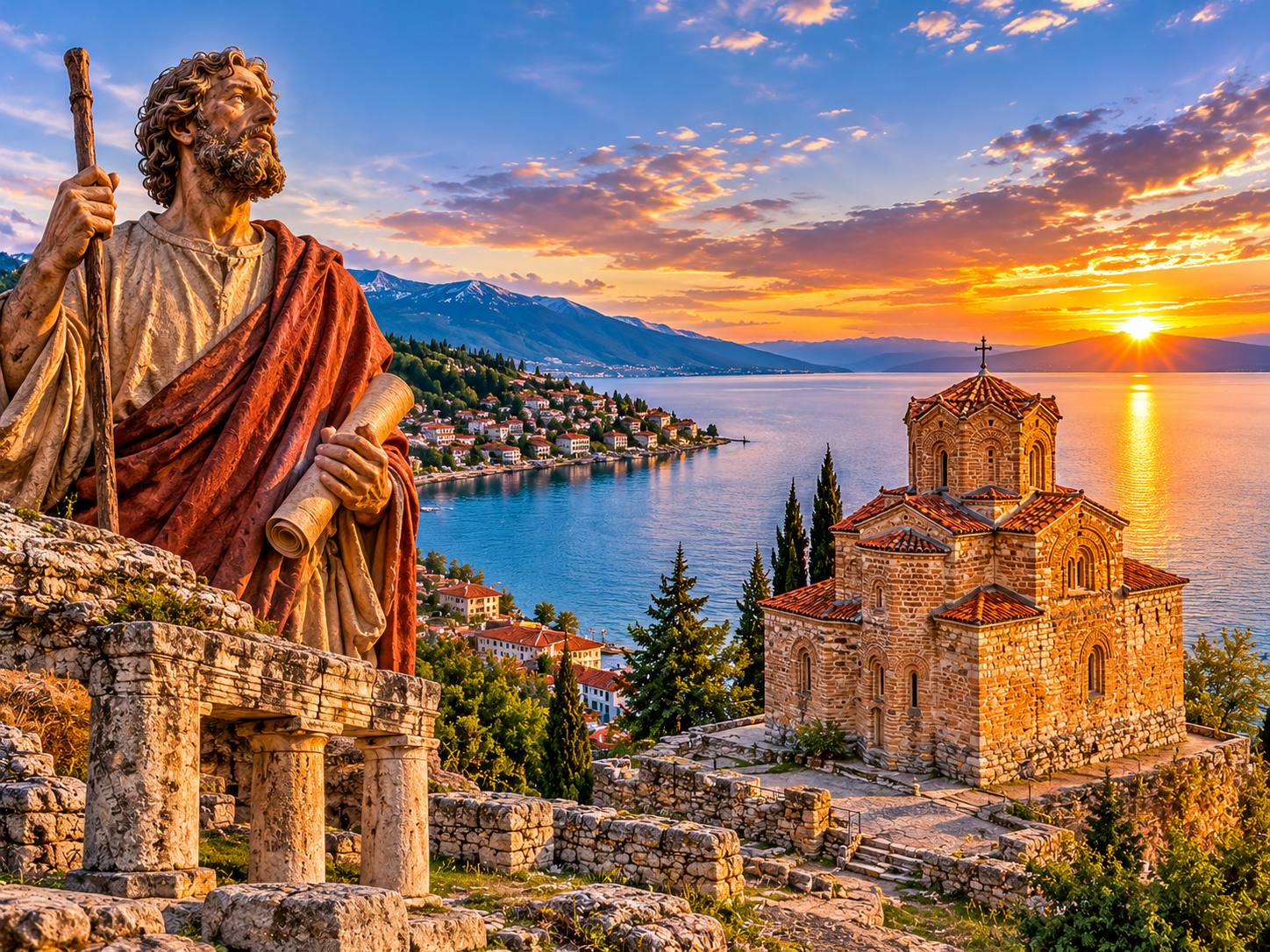
hrid, North Macedonia, is much more than a beautiful lakeside destination. Known as the Jerusalem of the Balkans, this historic city carries more than two thousand years of cultural, religious and historical heritage. From the ancient city of Lychnidos to the development of Slavic literacy and Christianity, Ohrid has played an extraordinary role in the history of the Balkan Peninsula.
Situated on the shores of one of Europe’s oldest lakes, Ohrid is a destination where ancient civilizations, Christian traditions and breathtaking natural beauty meet.
Macedonia in the Bible: A Land Mentioned in the New Testament
One fascinating historical connection between North Macedonia and Christianity comes from the Bible itself.
Macedonia is mentioned approximately 27 times in the New Testament, depending on the translation and counting method. One of the most significant references appears in Acts 16:9, when the Apostle Paul receives a vision of a Macedonian man asking him to come to Macedonia and help its people.
This event, commonly known as the Macedonian Call, marks an important moment in the spread of Christianity into Europe.
The Apostle Paul subsequently travelled to Macedonia, visiting cities such as Philippi, Thessalonica and Berea. These journeys helped establish some of the earliest Christian communities in Europe.
Although Ohrid is not explicitly named in this biblical passage, the wider Macedonian region has an important place in the history of early Christianity.
From Ancient Lychnidos to Modern Ohrid
Ohrid’s history stretches back thousands of years. In antiquity, the city was known as Lychnidos, an important settlement situated along the ancient Via Egnatia, one of the most significant Roman roads connecting the Adriatic coast with Constantinople.
Its strategic position made Lychnidos an important commercial, military and cultural centre.
Archaeological discoveries throughout the region reveal traces of prehistoric settlements, ancient civilizations and early Christian communities. The remains of ancient buildings, Roman infrastructure and early Christian basilicas demonstrate the city’s remarkable historical importance.
The name Ohrid appears in historical records in the ninth century, marking another chapter in the city’s long history.
Ohrid – The Jerusalem of the Balkans
During the Middle Ages, Ohrid developed into one of the most important Christian and cultural centres in the Balkans.
The arrival of Saint Clement of Ohrid and Saint Naum of Ohrid, disciples of Saints Cyril and Methodius, transformed the region into a major centre of Slavic education, literature and spirituality.
Saint Clement established an important educational and literary tradition at Plaošnik, helping spread literacy and Christianity among the Slavic peoples.
The Ohrid Literary School became one of the most influential educational centres of the medieval Slavic world.
The city’s extraordinary religious heritage is reflected in its historic churches, monasteries, frescoes and icons. Among its most famous landmarks are:
- Church of St. John at Kaneo – one of the most recognizable symbols of Ohrid.
- Church of St. Sophia – an outstanding example of Byzantine architecture.
- Monastery of St. Naum – an important spiritual destination near the Albanian border.
- Plaošnik – the archaeological and spiritual centre associated with Saint Clement.
- Samuel’s Fortress – a historic stronghold overlooking the old town and Lake Ohrid.
According to local tradition, Ohrid once had 365 churches, one for every day of the year.
Lake Ohrid – One of Europe’s Oldest Lakes
Ohrid’s history is inseparable from the lake that shares its name.
Lake Ohrid is estimated to be approximately two to three million years old, making it one of the oldest continuously existing lakes in Europe.
Its unique ecosystem contains more than 200 endemic species of plants and animals, including several species of fish found nowhere else in the world.
The combination of natural beauty, archaeological heritage and exceptional architecture makes the Ohrid region a place of outstanding universal value.
In 1979, Lake Ohrid was included on the UNESCO World Heritage List for its natural significance. In 1980, the cultural heritage of the Ohrid region was also recognized. The protected area was extended in 2019 to include the Albanian side of the lake.
Discover the History and Beauty of Ohrid
Walking through the narrow streets of Ohrid’s Old Town is like travelling through different periods of European history. Ancient ruins, Byzantine churches, traditional houses and panoramic views of the lake create an atmosphere unlike anywhere else in the Balkans.
Whether you are interested in ancient civilizations, religious heritage, architecture or simply discovering one of Europe’s most beautiful lakeside destinations, Ohrid offers something unforgettable.
If you are planning to explore Ohrid, the surrounding villages and the beautiful landscapes of North Macedonia, having a car gives you the freedom to discover the region at your own pace.
Explore Ohrid and its surroundings with Gogo.mk Rent a Car
Ohrid is not simply a destination. It is a living testament to thousands of years of history, faith and culture – a place where the past remains part of everyday life.